Get a scientific look at the world of Fantasy Football with Fantasy Professor John Bush and Dennis Michelsen. Yes, they are BOTH scientists who will teach you how to use the Scientific Method to improve your Fantasy statistics analysis.
Our dynamic duo discusses how the recent news affects your Fantasy team this week. We take a deep dive into the running back statistics. We show how the sport is changing and, therefore, how you need to change the way you look at the position in Fantasy Football.
—————————————
https://dmicmedia.sounder.fm/episode/science-of-fantasy-football-episode-29
————————————-
——————————-
Professor’s Take
——————————-
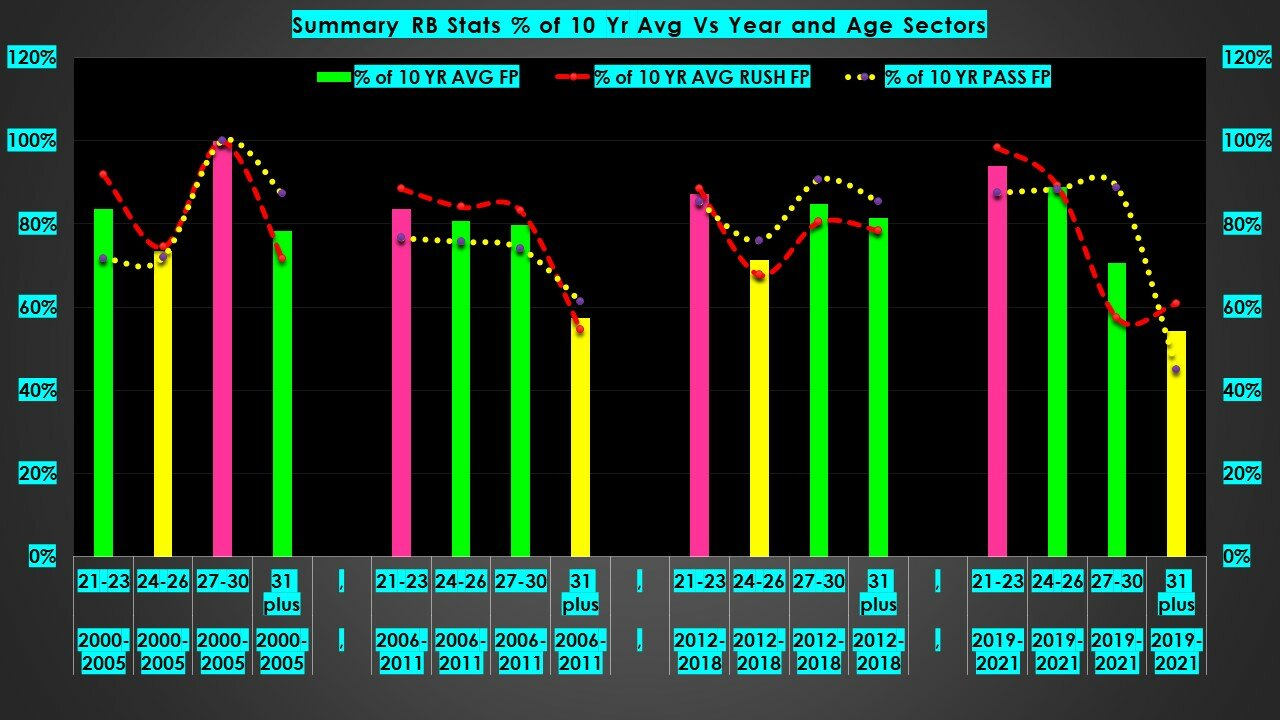
This figure shown above from my upcoming lesson on RB Metrics was discussed on our podcast. It is a snapshot of RBs from 2000 to 2021 by years, RB age groupings with rushing and reception-based fantasy points.
Fake Pigskin Exclusive: Join Monkey Knife Fight and Get an Instant 100% Deposit Match PLUS a Free $5 Game!
I have grouped the years into four segments 2000 to 2005, 2006 to 2011, 2012 to 2018, and 2019 to 2021. Additionally, I included the yearly RB average Fantasy Points by age sector via the Bars (Pink is the highest FP average vs. Yellow is the lowest FP average). The red line charts the rushing FP while the yellow lines present the pass-catching FP.
I note a change in these metrics within the 2019 to 2021 RB grouping. The early ages have a rushing bias from 21 to 26 yrs, while the older RBs after 26 seem to have a more robust passing activity. The extremes of rushing vs. passing FP are apparent. This finding suggests a future shift in our dynasty approaches to drafting. Look for older RB with pass-catching activity and younger RBs having a solid rushing game.
I note this change for redrafts as well. Award extra credits for the”model RB” within the age sectors.